 Cleanzine: your weekly cleaning and hygiene industry newsletter 5th November 2026 Issue no. 1233
Your industry news - first
The original and best - for over 20 years!
We strongly recommend viewing Cleanzine full size in your web browser. Click our masthead above to visit our website version.


Uni Europa calls on EU to follow Iceland’s new procurement guidelines for cleaners
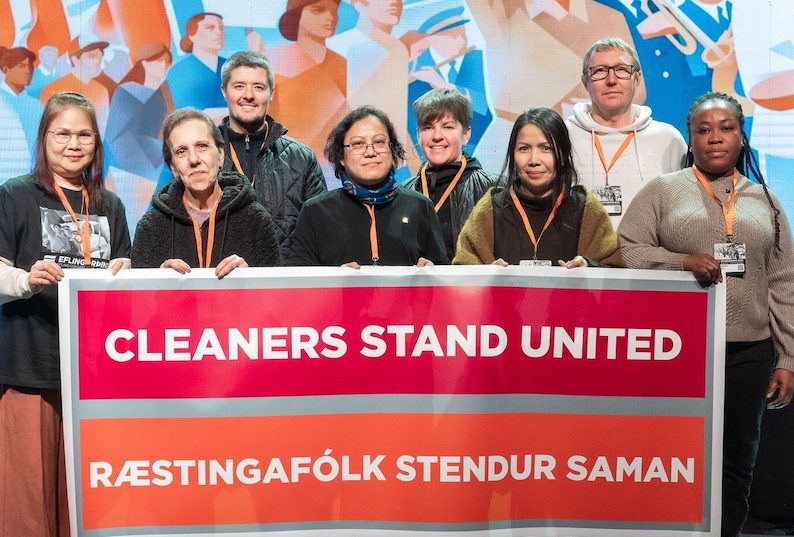 Yesterday, in response to union pressure, Iceland’s Ministry of Finance & Economic Affairs issued new stricter guidelines for public procurement cleaning contracts that strengthen collective agreements and measurable work targets.
The Uni Europa Union and its Icelandic affiliate Efling are welcoming these and Uni Europa is calling on the EU to follow suit with its own procurement reforms.
The guidelines are designed to strengthen bidders’ compliance with applicable collective agreements and labour laws: Bidders will need to submit a declaration of compliance, and the trade union representing the prospective workers will need to confirm it. A cleaning contractor with confirmed cases of paying wages below the legal minimum or other irregularities can be refused confirmation by the union, potentially leading to exclusion from the bid.
Bidders will also need to note how many hours in total they expect the respective cleaning job to take. For jobs larger than 1,000sq.m, the contracting authority must ask an independent party to assess how many hours the job should take. This is designed to stop bidders from underestimating labour costs and should, in turn, prevent them from paying their workers too few hours – a practice which generally forces the workers either to work at an unreasonable pace or to deliver less than the tender requires. A bid will need to be rejected if it does not meet the collective agreement’s minimum standards on how much work can be demanded of workers.
“I know from my own experience how hard it is for cleaners when the workload is excessive,” says Beata Prokop, a cleaner and Efling union representative. “My workday is not supposed to be like an endless gym class.
“The big public buyers, like the University of Iceland where I clean, should do their part in preventing that kind of situation. I hope the new guidelines will guarantee that, and make a positive change happen for all cleaners around Iceland who are working hard - sometimes way too hard - to keep our schools and hospitals clean.”
The guidelines build on existing cleaning industry standards for output, work pace and hours - originally developed in Denmark - which make use of standardised 3-digit cleaning frequency codes applied to each room on the cleaning plan using floor drawings. These standards are also referred to in the existing collective agreement between Efling and the Confederation of Icelandic Enterprise (SA) for cleaning work. The agreement sets a maximum work pace and requires extra pay for work done at a faster pace.
Sólveig Anna Jónsdóttir, chairman of Efling, says:
“I am very pleased with these guidelines. They will help make sure that Efling members who work in cleaning are not subjected to wage theft or excessive workloads. Unfortunately, we have seen far too many examples of both in recent years. I welcome the fact that the government listened to us, and that years of work are now paying off.”
Public procurement rules - in Iceland as in the EU, generally promote the lowest price in procurement, argue the unions, who say that four to five leading cleaning contractors compete intensely for public cleaning contracts in Iceland, with some bids differing by large, unexplained amounts. Efling’s view is that in many cases the companies are competing mainly on how much workload they demand of their staff, and that these demands often go beyond what collective agreements allow. Workloads this heavy are also a health & safety risk, it says.
The guidelines were developed in consultation with Efling and the Federation of General & Special Workers in Iceland (SGS), and were published in the government’s online consultation portal prior to approval. The employers’ federation of Iceland (SA) objected to the guidelines.
The guidelines apply to all institutions directly under the Icelandic state. These include, to name a few, the University of Iceland, the National University Hospital of Iceland, government ministry buildings, upper secondary schools, police and district commissioner offices, and the State Alcohol & Tobacco Company (ÁTVR). Other public bodies, such as municipalities, can also choose to use them.
UNI Europa Regional Secretary Oliver Roethig comments:
“Iceland’s new procurement guidelines shows why it is important that lawmakers listen to workers when writing public procurement rules. Effective consultation between social partners and governments improves working conditions for services workers and improves service quality for public institutions and citizens. We call on the European co-legislators to learn from Iceland’s example and ensure that EU procurement rules promote better jobs and collective bargaining.”
22nd October 2026