 Cleanzine: your weekly cleaning and hygiene industry newsletter 5th November 2026 Issue no. 1233
Your industry news - first
The original and best - for over 20 years!
We strongly recommend viewing Cleanzine full size in your web browser. Click our masthead above to visit our website version.


What your FM client checks in your COSHH, and the five gaps they find
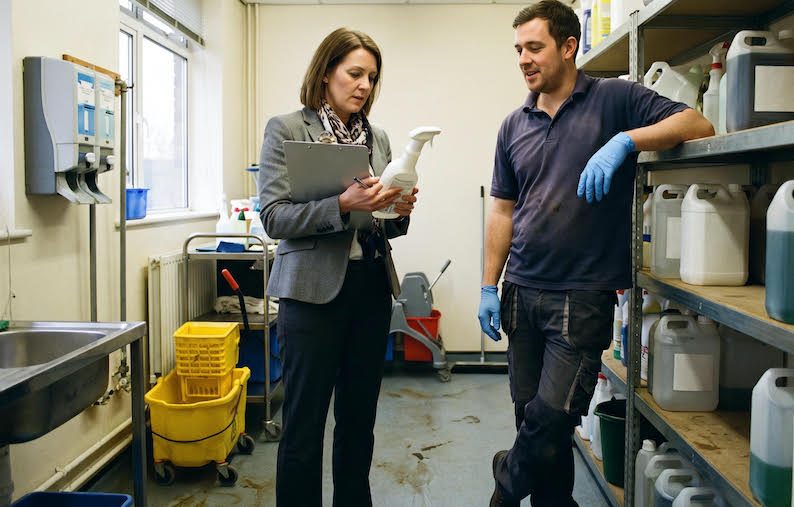 Cleaning contractors rarely lose a contract over the cleaning; they lose it over the paperwork behind it, argues Nathan Winter, founder of swiftRMS. Here Nathan sets out what an auditor looks for in a cleaning contractor's COSHH (Control of Substances Hazardous to Health) assessments, and how to close the gaps before the next visit…
“The auditor doesn't start with your folder. They start with the cupboard. They open the cleaner's store on the client's site, pick up three bottles and write down the names. Then they ask to see the COSHH assessments for those three products, and the operative who uses them. That 10-minute check tells them more than the binder ever will, because it shows whether the paperwork describes the job that's actually being done.
The Control of Substances Hazardous to Health Regulations 2002 ask for a "suitable and sufficient" assessment of the risk, controls that work, and staff who know what those controls are. Most contractors have assessments. The trouble is what's in them. These are the five gaps that come up most.
1. The assessment describes the product, not the task
A common COSHH assessment is the safety data sheet copied into a template. It lists the hazards from the bottle and stops there.
But the risk depends on how the product is used. A descaler wiped onto a sink is a different job from the same descaler sprayed in a small, unventilated washroom. A concentrate decanted by hand is riskier than one dispensed through a dilution unit. The safety data sheet can't know any of that. Your assessment has to say it: the task, where it's done, how much and how often, and the controls for that.
The fix: write each assessment around a task ("daily washroom clean, ready-to-use descaler, trigger spray"), not just a product name.
2. The cupboard doesn't match the folder
Products change all the time. A supplier swaps a line, a site manager buys something cheaper locally, or the client leaves their own products for your team to use. The folder at head office still lists last year's range.
An auditor who finds a bottle with no matching assessment has found a real gap, not a paperwork one. Nobody has assessed the thing your staff are actually using.
The fix: keep a product list for each site, check it against the cupboard at every supervisor visit, and treat any new product as a trigger to assess it before it's used. That includes the client's products.
3. The assessment is out of date
Suppliers reformulate, and a new safety data sheet can change a hazard classification without the product name changing at all. An assessment written against a five-year-old sheet may be describing a product that no longer exists.
The regulations require an assessment to be reviewed when there's reason to think it's no longer valid, or when the work changes. Auditors look at the date on the sheet and the date on the assessment, and ask how you'd know if either had moved.
The fix: ask suppliers to send updated safety data sheets automatically, set a review date on every assessment, and record the review even when nothing changes.
4. The controls are too vague to follow
"Wear gloves" isn't a control an operative can act on. Which gloves? Disposable vinyl and nitrile give very different protection, and section 8 of the safety data sheet often names the material needed. The same goes for "ensure adequate ventilation" in a windowless toilet block.
The control auditors ask about most is mixing. Bleach combined with an acid-based toilet cleaner or descaler gives off chlorine gas. If your assessments don't say plainly what must never be mixed, and your team doesn't know it, expect a question.
The fix: name the glove type, the dilution rate, the ventilation step and the never-mix rules in plain words, so an operative could follow them without asking.
5. The people doing the work can't explain it
The regulations require employers to give staff information, instruction and training about the substances they use. An auditor tests that in the simplest way: they ask a cleaner what the product does, what gloves they wear and what to do if it splashes in their eyes.
Early-morning and evening shifts, high staff turnover and teams who don't read English well all make this harder. A signed training record from two years ago doesn't help if the person in front of the auditor started last month.
Skin is the other thing to check. Cleaners are among the workers most at risk of dermatitis from wet work and cleaning chemicals, and HSE guidance recommends regular skin checks where that risk exists.
The fix: brief each new starter on the products at their site before their first shift, use pictures and translated summaries where needed, and keep simple records of skin checks.
Check it before they do
Pick one site this month. Open the cupboard, list what's in it and pull the assessments. Then ask the operative on shift three questions about the products they use. If the bottles, the paperwork and the answers all match, you're ready for the client. If not, you've found your gaps before they did.’
Nathan Winter is the founder of swiftRMS, which builds RAMS (Risk Assessment Method Statement) and COSHH software for UK contractors.
22nd October 2026