 Cleanzine: your weekly cleaning and hygiene industry newsletter 5th November 2026 Issue no. 1233
Your industry news - first
The original and best - for over 20 years!
We strongly recommend viewing Cleanzine full size in your web browser. Click our masthead above to visit our website version.


How big is the infection control market, and what is driving its growth?
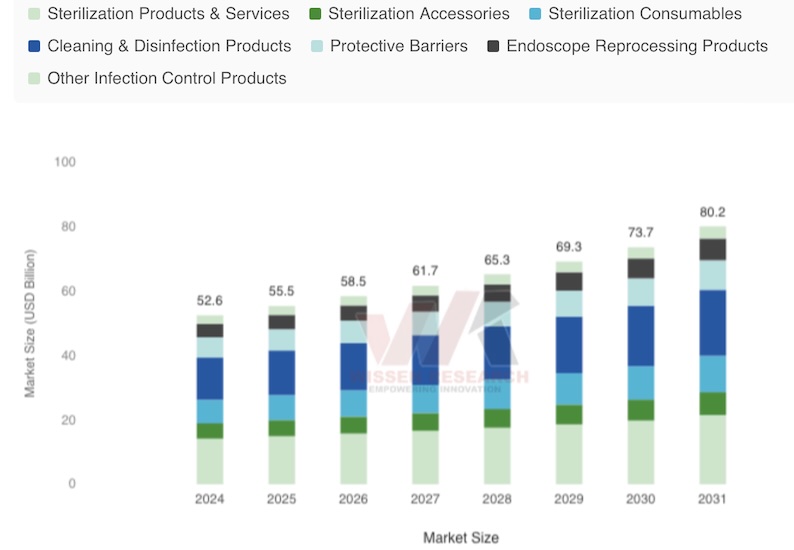 The global infection control market is valued at USD 58.5 billion in 2026 and is projected to reach USD 80.2 billion by 2031, growing at a Compound Annual Growth Rate of 6.5% over the forecast period (2026-2031), according to a new study by Wissen Research.
The reason shows up in hospital data. The US Centers for Disease Control & Prevention estimates that one in 31 hospital patients has at least one healthcare-associated infection on any given day, and counted approximately 518,000 HAIs in US acute-care hospitals in 2023. Prevention is working in places: in 2024, US acute-care hospitals reduced central line-associated bloodstream infections by 9%, catheter-associated urinary tract infections by 10%, and C.difficile infections by 11%. But the picture is uneven, and abdominal hysterectomy surgical-site infections rose 8%, which is why surveillance and prevention remain necessary.
Globally, the readiness gap is wider. The World Health Organisation's 2024 report found that only 15.8% of 4,183 assessed healthcare facilities met all minimum infection prevention & control requirements, and WHO and UNICEF estimate that only 57% of health facilities worldwide had basic hygiene services in 2022. That mix of constant demand and uneven readiness is shaping a market for sterilisation, disinfection, reprocessing and monitoring.
Proving the clean: monitoring and hygiene programs move from products to services
Infection surveillance in healthcare facilities is becoming more systematic, with greater emphasis on verifying that cleaning was done and standards were met. WHO found that 78% of secondary and tertiary healthcare institutions surveyed have IPC monitoring systems in place, which leaves room to improve measurement and reporting.
Suppliers are responding with tools that help hospitals prove the result. Ecolab has introduced an environmental hygiene monitoring system that checks cleaning efficiency and supports compliance with standards, and Solventum's Attest sterilisation assurance portfolio of biological and chemical indicators carries independent BSI Kitemark certification, a verifiable quality attribute for procurement teams.
The scope is widening beyond disinfectants too. WHO's 2024 global IPC report says infection prevention should be integrated with water, sanitation, hygiene and waste management, and the report notes that providers with complementary disinfection chemicals, hygiene products, water-safety technologies and implementation services can serve multiple needs within the same facility. Companies are already positioning for different parts of the workflow: Steris is expanding its surgical consumables portfolio, Getinge is developing automated reprocessing workflows, and Ecolab emphasises environmental hygiene programs and analytics.
Reprocessing Is going automatic: reprocessors, robotics, and low-temperature sterilisation take on the workload
Every reusable instrument that touches a patient has to be cleaned, then disinfected or sterilised, before it touches the next one. The US Food & Drug Administration lists surgical forceps, endoscopes and laryngoscopes among the devices that need this treatment, and describes medical device reprocessing as a detailed, time-consuming job that is prone to errors. That is why the market is leaning on automation. Automated washer-disinfectors improve the consistency of instrument reprocessing, hydrogen peroxide-based low-temperature sterilisation handles heat-sensitive instruments that cannot withstand steam, and UV-C disinfection gives hospitals another option for the environment.
Recent launches show how far this has gone. In June 2026, Getinge introduced the Aquadis Endo 110 automated endoscope reprocessor, which raises processing throughput by up to 36% and runs a standard 20-minute cycle with automated program selection and traceability features. In December 2025, it introduced its Automatiq range, which combines mobile robotics, intelligent conveyors, automated loading and unloading, and workflow software for sterile reprocessing. In June 2026, Advanced Sterilization Products took a majority stake in UV Smart, a Dutch provider of UV-C high-level disinfection technology for specialty equipment such as transesophageal echocardiography probes. The report's takeaway for suppliers is that differentiation increasingly depends on validated pathogen reduction, device compatibility, process traceability, and manageable lifecycle costs rather than technology novelty alone.
What's fueling growth in the infection control market
- A high burden of healthcare-associated infections: HAIs that develop during treatment push facilities to adopt more effective disinfection, sterilisation and hygiene techniques to prevent patient complications.
- Reprocessing of reusable devices: Surgical instruments, endoscopes and other reusable devices need validated cleaning, disinfection and sterilisation, which creates continuing demand for reprocessing equipment and consumables.
- More surgical and invasive procedures: Procedures involving instruments that enter sterile tissue or blood require hospitals to have more demanding sterilisation capacity.
- Antimicrobial resistance and prevention priorities: The link between HAIs and antimicrobial resistance is prompting greater attention to environmental cleanliness, protective equipment and preventing the spread of pathogens.
- Stricter infection-control protocols: Clinical guidelines require facilities to buy appropriate disinfectants and sterilisers for critical instruments and high-level disinfection for semi-critical ones.
- Demand beyond hospitals: Pharmaceutical and biotechnology companies, medical device manufacturers and diagnostic laboratories need contamination control, and the FDA notes that small inpatient and outpatient facilities, medical-office suites, and ambulatory surgery centres also reprocess reusable devices.
Challenges facing the infection control market
The hard part is that devices are not designed to be easy to clean. The FDA identifies narrow internal channels, valves, hinges and inaccessible surfaces as features that can retain biological debris and complicate effective cleaning and sterilisation. Reprocessing is labour-intensive and prone to error, so it needs trained staff, appropriate equipment and standardised procedures. Manufacturers must also validate reprocessing instructions to show that cleaning, disinfection, or sterilisation works consistently, and disinfectants and sterilisation methods must be compatible with the materials in each device.
Cost and infrastructure add to the load. Sterilisers and automated reprocessing systems need installation, maintenance, staff training and supporting infrastructure, and suppliers face pressure to show compatibility, reliability, manageable operating costs and simpler workflows - particularly when selling advanced systems to resource-constrained facilities.
In fragile settings, 37% of healthcare facilities lacked basic water services and 54% lacked basic hygiene services in 2023, which limits the infrastructure available to support effective infection prevention.
Recent strategic developments in the infection control market
In October 2026, Steris of Ireland agreed to acquire Xodus Medical, a specialty surgical products manufacturer, for USD 2.1 billion. Xodus Medical's projected 2026 revenue is approximately USD 245 million, and the acquisition expands Steris's healthcare consumables portfolio with patient-positioning systems and operating-room safety products, complementing its hospital infection-prevention and sterilisation business. The transaction is subject to regulatory approvals and closing conditions. In the same month, Steris announced a USD 600 million manufacturing and distribution investment in North Carolina, including facilities serving healthcare and pharmaceutical sterilisation and disinfection chemical markets.
In September 2026, Reckitt Benckiser Group of the UK announced an investment of up to USD 600 million in its US operations, including a science and innovation centre focused on disinfection, microbiology and surface care. The investment is intended to strengthen research and development and accelerate innovation across its germ-protection portfolio, including Lysol products.
In June 2026, Getinge AB of Sweden launched the Aquadis Endo 110 automated endoscope reprocessor, designed to improve endoscope cleaning and high-level disinfection. It increases processing throughput by up to 36%, offers a standard 20-minute cycle, and adds automated program selection and traceability to support infection-prevention workflows.
In June 2026, Advanced Sterilisation Products of the US acquired a majority stake in UV Smart, a Dutch provider of UV-C high-level disinfection technology for specialty medical equipment, expanding its infection-prevention portfolio and strengthening its capabilities in faster, more efficient disinfection and device reprocessing.
The four announcements span consumables, research, reprocessing automation, and UV-C disinfection - a reminder that suppliers are targeting different parts of the infection-control workflow.
Key insights from infection control market analysis
- Sterilisation products and services held the largest share by product type in 2025. Reusable devices need repeated reprocessing, device makers must ensure products designated sterile undergo validated sterilisation, and contract sterilisation serves manufacturers without dedicated capacity. Biological and chemical indicators, packaging and other accessories create recurring consumables demand alongside equipment purchases.
- Hospitals and clinics held the largest share by end user in 2025. The CDC's National Healthcare Safety Network receives data from more than 70,000 hospitals, long-term-care facilities, and other healthcare facilities, and hospital reprocessing involves a multistep process of decontamination, thorough cleaning, and then disinfection or sterilisation, supporting demand for cleaning solutions, reprocessing equipment, and sterilisation consumables.
- North America is the leading region, supported by established infection surveillance infrastructure, detailed FDA requirements for reusable-device reprocessing, and continuing supplier investment in US manufacturing.
- Asia Pacific is the fastest-growing region, with health systems and clinical services expanding and a need to strengthen infection prevention. Hospitals and outpatient clinics require sterilisation equipment, disinfectants, protective gear and reprocessing solutions as healthcare delivery grows. The report adds that infrastructure indicators, such as the 90% of healthcare centres in the region with basic water sources in 2021 against 78% globally, signal potential but do not rank regional market growth.
- The market is moderately consolidated in specialised segments such as sterilisation equipment, contract sterilisation services and automated reprocessing systems, while remaining fragmented across disinfectants, protective barriers, consumables and regional suppliers. Acquisitions, partnerships, and portfolio expansion are driving consolidation.
Key players in the infection control market
Leading companies in the infection control market are focusing on advanced sterilisation technologies, healthcare disinfection solutions, infection-prevention consumables, automated medical-device reprocessing and expansion of sterilisation services across hospitals, clinics, laboratories and life sciences facilities.
The report names Steris plc (Ireland), Getinge AB (Sweden), Ecolab (US), Solventum Corporation (US), and Advanced Sterilization Products (US) as the top five players, participating in sterilization equipment and services, cleaning and disinfection, infection-prevention products, and medical device reprocessing. The leaders are differentiating in different ways. Steris is expanding into surgical consumables, Getinge pairs sterilisation equipment with cleaning detergents, packaging, sealers, indicators and automated reprocessing workflows, Ecolab combines cleaning products, standardised hygiene workflows, staff training and digital dashboards, and Solventum offers sterilisation indicators and process challenge devices.
Other companies profiled in the report include Belimed AG (Switzerland), Matachana Group (Spain), MMM Group (Germany), 3M Company (US) and Sotera Health Company (US). The report also covers Cantel Medical, Midmark, Tuttnauer, Miele, Steelco, Metrex Research, PDI, Reckitt Benckiser, Diversey, Kimberly-Clark, Cardinal Health, Medline Industries, Xenex Disinfection Services and W&H, among others.
Regional analysis and growth opportunities
North America leads the infection control market. The CDC's surveillance network supports structured infection prevention across more than 70,000 healthcare facilities in the US, and FDA guidance on reusable-device reprocessing sets requirements for cleaning, disinfection, sterilisation, and validated instructions, which supports demand for compliant products. Supplier investment continues, including Steris's USD 600 million North Carolina manufacturing and distribution project announced in October 2026.
Asia Pacific is the fastest-growing region. Expanding healthcare delivery and the need to strengthen infection prevention are increasing demand for sterilisation equipment, disinfectants, protective gear and reprocessing solutions in hospitals and outpatient clinics.
Europe, Latin America, and the Middle East & Africa complete the report's regional coverage.
The report's message is that competition is moving beyond the product itself. Winning suppliers will need validated pathogen reduction, device compatibility, process traceability and manageable lifecycle costs, and they will need to help hospitals prove that the clean was done. For facilities, the work ahead is closing the gap between infection-prevention requirements and what is actually in place.
Get a free sample of this report at:
29th October 2026