 Cleanzine: your weekly cleaning and hygiene industry newsletter 18th June 2026 Issue no. 1215
Your industry news - first
The original and best - for over 20 years!
We strongly recommend viewing Cleanzine full size in your web browser. Click our masthead above to visit our website version.


Injured, unpaid and unable to say no: How extreme weather is punishing cleaners and security officers
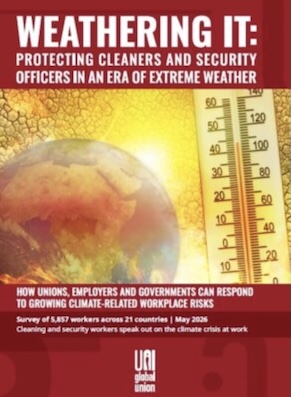 More than six in 10 cleaning and security workers worldwide say extreme weather has made their work harder or more dangerous in the past three years, according to a new survey by UNI Global Union.
The report - ‘Weathering it: protecting cleaners and security officers in an era of extreme weather’, documents the physical harm, income loss and psychological toll being borne by some of the lowest-paid workers in the global economy - workers who cannot retreat indoors, log in from home, or refuse a shift without losing their earnings.
The survey, conducted between April and May 2026 through union communication channels in 21 countries, reached 5,857 cleaning and security workers from Sub-Saharan Africa, Southeast Asia, South Asia, Latin America, North Africa and Europe. Responses were weighted by national cleaning and security workforce size to ensure that large labour markets such as India, Indonesia and Brazil are accurately represented in the aggregate findings.
Key findings:
• 62% say extreme weather has affected their work in the past three years
• 71% report at least one physical health impact from working in extreme weather
• 35% have lost shifts or income directly because of extreme weather
• 75% say extreme weather has made travelling to or from work difficult or dangerous
• 57% report stress or high stress during extreme weather (rising to 67% among security officers)
• Some 25% of employers have taken no protective action whatsoever
• 4.9% have access to paid leave during weather emergencies
• 7.2% have access to safety training for extreme weather
The report finds that the problem is not confined to regions associated with extreme heat. Workers across Northern Europe describe cleaning industrial spaces at temperatures exceeding 50 degrees Celsius with no ventilation, patrolling outdoors during red weather warnings and losing pay when ice or snowstorms make travel impossible. In Sub-Saharan Africa, cyclones have destroyed workers' homes, creating a double crisis of personal safety and job insecurity. In Southeast Asia, security officers are breathing air with particulate matter readings above PM 400 - hazardous by any international standard - with no protective equipment provided.
The financial dimension is acute. For workers already at or near the minimum wage, the 35% who have lost income due to extreme weather face an impossible choice: expose themselves to dangerous conditions or forgo pay. Only 4.9% have access to paid leave during weather emergencies - a figure that underscores how far employer provision lags behind the scale of the risk.
"The time for treating extreme weather as a temporary inconvenience is over,” argues - Christy Hoffman, General Secretary, UNI Global Union. “It is rapidly becoming our new normal - and our workers cannot wait for the rest of the world to catch up."
The survey also reveals a significant divergence between the two occupational groups covered. Security officers - who make up 65.9% of respondents and are more frequently deployed at fixed outdoor posts - report higher rates of income loss (43% , versus 33% for cleaners), a higher average stress score during extreme weather (6.46 out of 10, versus 5.27), and markedly less access to paid leave (2.3%, versus 7.3% for cleaners). Cleaners, meanwhile, face a different set of hazards: industrial spaces with inadequate ventilation, hospital corridors with no cooling, and outdoor cleaning tasks in conditions that most employers treat as routine.
Michala Lafferty, head of property services, UNI Global Union, says:
"What this report shows is that extreme weather is not an abstract risk for our members - it is something they are living with every shift, in every country we work in. These workers keep hospitals clean, airports safe and office buildings running. They deserve the same duty of care as anyone else on the payroll. The data gives unions the evidence they need at the bargaining table, and it gives governments and employers nowhere left to hide."
Regional and country findings:
The report covers 21 countries across six regions. Selected findings illustrate the breadth and severity of the problem:
* Kenya: 85% of workers say extreme weather has affected their work in the past three years - the second highest national rate in the survey. Some 64% have lost income due to extreme weather, with almost no access to paid leave or safety training. Travel to work becomes impossible during heavy rains, yet attendance is still expected.
* Malawi: 71% of workers have lost income because of extreme weather - the highest rate of any country surveyed, and double the global average. 68% of employers provide no protection whatsoever. Several workers report that cyclones have destroyed their homes, compounding a crisis of physical safety and job insecurity.
* Uganda: 78% of workers have lost income due to extreme weather - nearly three times the global average - and 92.5% say travel to or from work has been made difficult or dangerous, the highest travel-risk rate of any country in the dataset.
* Zimbabwe: 47% of employers provide no protection during extreme weather. Not one worker – 0% - has access to paid leave during weather emergencies. Security officers describe standing alone in open spaces during lightning storms at night.
* Thailand: 65% of employers provide no protection during extreme weather - nearly three times the global average. Security officers report working outdoors in air with particulate matter readings above PM 400. Illness resulting from hazardous air quality is dismissed by some employers as fraudulent sick leave.
* Indonesia: 83% of workers say extreme weather makes travel to or from work difficult or dangerous. Some 44% report headaches or dizziness - significantly above the global average of 32%. Flooding and fallen trees are a regular feature of workers' daily commutes.
* Peru: 48% of workers have experienced heat exhaustion or dehydration at work - the highest rate in Latin America. 37% of employers provide no protection at all. One security officer described health deteriorating year after year from the cumulative effects of outdoor exposure.
* Brazil: 94% of security officers - the highest rate in Latin America - report stress above the midpoint of a 10-point scale during extreme weather. Some 40% of workers have lost income due to extreme weather, with only 2.9% having access to paid leave.
* Tunisia: 69% of workers have lost income because of extreme weather. Some 51% of employers provide no protection. Workers report wages reduced by weather-related absences, alongside deteriorating health.
* Finland: Workers describe cleaning industrial machine halls at temperatures exceeding 50 degrees Celsius, and cleaning building exteriors in horizontal sleet. Some 59% believe extreme weather is becoming more frequent. Yet only 0.9% - effectively none - have access to paid leave during weather emergencies.
* Ireland: 5% of employers provide no protection during extreme weather. Security officers report being expected to patrol outdoors during red weather warnings when all other workers have been advised to remain at home. One worker described feeling their life was "unimportant and expendable”.
* Spain: 83% of workers say extreme weather has affected their work, with the DANA flooding events cited directly as an occupational safety threat. Not a single worker in the Spanish sample reported access to safety training for extreme weather.
Workers' voices:
The survey collected open-text responses alongside quantitative data. Workers' accounts reveal the human reality behind the statistics…
"It makes me feel that my life is unimportant and expendable, as I have to go to work while everyone else is told to stay at home" - Cleaning and security worker, Ireland
"Since I am the only security guard on duty in extreme weather conditions, I have to go no matter what happens" - Security officer, Türkiye
"I work in unsafe weather all the time but still can't afford the treatment I may need after health issues caused by extreme weather" - Security officer, Zimbabwe
Recommendations:
UNI Global Union is calling on three audiences to act:
For employers - immediately: provide drinking water, shade and rest breaks whenever temperature thresholds are exceeded; ensure outdoor workers have weatherproof clothing before extreme weather events; establish rest areas at every fixed worksite; introduce paid leave provisions for workers who cannot safely travel to or work on-site during declared weather emergencies; and create non-punitive channels for workers to raise safety concerns.
For trade unions: negotiate extreme weather clauses into collective agreements covering minimum temperature thresholds for outdoor work, mandatory provision of water, rest and shelter, and income protection during weather-related absence. Campaign for hazard pay provisions for outdoor workers during declared weather emergencies.
For governments: enact mandatory heat stress protocols in occupational safety and health legislation; extend paid leave entitlements to cover declared weather emergencies; enforce occupational safety obligations on client organisations as well as direct employers; and ratify ILO Convention No. 155 on Occupational Safety & Health.
The full report, including a methodology note, country-level data annex and policy recommendations, is available at:
https://uniglobalunion.org/wp-content/uploads/weathering-it-report.pdf
18th June 2026