 Cleanzine: your weekly cleaning and hygiene industry newsletter 26th November 2026 Issue no. 1236
Your industry news - first
The original and best - for over 20 years!
We strongly recommend viewing Cleanzine full size in your web browser. Click our masthead above to visit our website version.


UK's dirtiest public toilets 2026: which cities rank worst?
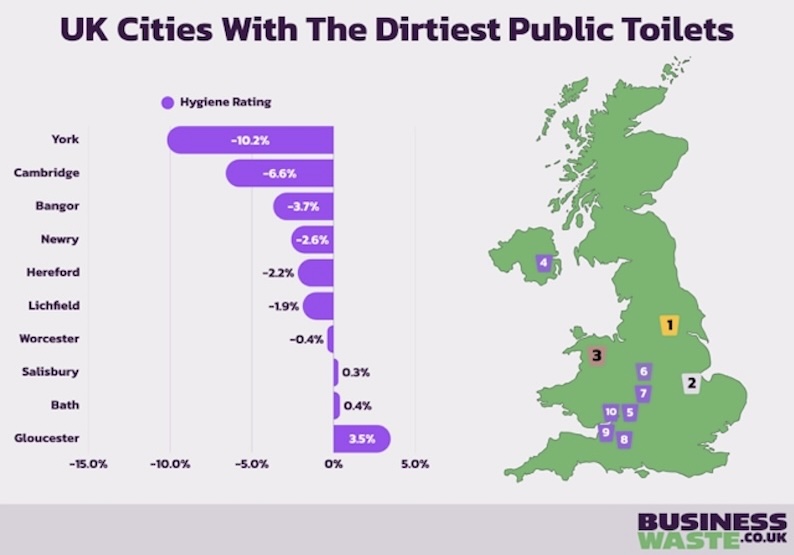 New research has backed up just how strongly public toilet cleanliness influences where people choose to spend their time, with 68% of consumers admitting they have avoided using a venue's washrooms because they did not meet their needs. Among those consumers, 79% cited cleanliness as a concern.
To understand where standards remain high (and where they don't), sanitary waste disposal experts at BusinessWaste.co.uk have ranked the UK cities with the dirtiest and cleanest public toilets, based on Google Review data. They also examine whether paid toilets are cleaner than facilities that are free for the public to use.
York has the dirtiest public toilets in Britain:
York ranks in first place for having the dirtiest public toilets in the UK, with an overall hygiene score of -10.2/100. Despite having just 11 public toilets across the city, more than 32% of reviews mention the word "dirty", giving York an average Google rating of 3 out of 5. While London has over 10 times more public toilets, these were far less criticised, with only 12.4% of reviews using the same term. To add insult to injury, five of these toilets require payment to use, and most of these received negative reviews, with many mentioning the bad smell, number of flies, lack of soap and broken hand dryers.
Cambridge takes second place, with one of the lowest "clean" ratings in the UK, as only 6.3% of reviews mentioned cleanliness. With an average rating of 2.6 out of 5, its toilets received a poor overall hygiene score of -6.6/100, which is -15.1 pp lower than when the data was collected last year. One reviewer quoted, "Broken toilet roll dispenser, missing toilet seat, bad graffiti, mess everywhere, hand dryer not working and people using drugs inside". Being one of the world's leading university cities, Cambridge's public toilet standards suggest there is significant room for improvement.
In third place is Bangor, having seen one of the sharpest declines in hygiene scores since last year, falling from 26.5/100 to -3.7/100. Of the 18 Google reviews across its two public toilets, seven mentioned dirtiness and only two referred to cleanliness. However, the facilities still maintained an average Google rating of 3 out of 5.
Newry is fourth, with a hygiene rating of -2.6/100, which is down 2.6 percentage points from last year. Of the three reviews from its three public toilets, two mentioned dirtiness, and none referred to cleanliness. One review said, "Stinking and no loo roll, disgrace on the local council!"
Hereford comes in fifth, having seen its hygiene score fall by 33.1 percentage points from 30.9% last year to -2.2% this year, which is the biggest drop among all the cities in the top 10. Interestingly, the city's only toilet included in the study still has a fairly positive Google rating of 3.6 out of 5 despite other reviews mentioning "explosive diarrhoea on walls".
Other complaints referenced public health hazards such as:
- "I took my son in, who uses a wheelchair, and we had to leave immediately" in York
- "I had to shout until someone heard me to let me out of the disabled toilets!" in Nottingham
- "Found a used drug needle in the disabled toilets" in Derby
- "A dirty baby changing area" in Sheffield
- "Used condoms and tampons" in Salisbury
- Pictures of overflowing sanitary bins in Bath
- "Paid 40p to enter and was immediately greeted with a horrible stench and hundreds of flies."
You might expect that paying more to use a toilet would mean cleaner facilities, but the data shows that free or low-cost public toilets tend to have higher hygiene ratings, while pay-to-use toilets are often dirtier on average. These include:
- 2theloo (London): £1.50 charge, 19% of reviews mention "dirty" - average rating 2/5.
- Cutty Sark (London): 50p charge, 46% of reviews mention "dirty" - average rating 1.8/5.
- St Leonard's Place (York): 50p charge, 68.5% mention "dirty" - average rating 1.7/5.
- Plymouth, Perth, and Derby charge around 50p per visit but still rank amongst the worst for hygiene.
"Despite higher costs, users are paying far more than a penny for disappointing standards," says Mark Hall, sanitary waste disposal expert and a director at BusinessWaste.co.uk. "Public toilets are an essential service, yet they're disappearing faster than ever. Our results show that many of these aren't left in a clean, hygienic condition, which not only presents a public health concern but also an accessibility issue for those with disabilities who rely on these spaces every day."
"It's also shocking that many of the dirtiest toilets are ones that charge users, as it raises questions about where that money is actually going, as it should be reinvested into keeping these facilities clean and safe for us all to use."
"In a time of both national and local budget cuts, services that we take for granted can fly under the radar. But we recommend that local councils and facilities management professionals invest more into maintaining existing public services like toilets, so that they are clean, safe and accessible enough for us all to use."
The full dataset with all metrics analysed can be found at:
Methodology:
1 Data was scraped from Google Maps to gather public toilet listings for all UK cities. 742 toilets and 10,432 reviews were analysed. Any duplicate listings or listings for toilets within businesses were removed.
2 Data was then manually collected for each Google map listing to gather the number of toilets, the average rating, the number of reviews, the number of reviews mentioning toilets that are dirty, and the number of reviews mentioning toilets that are clean.
3 A hygiene rating that considers each city's net cleanliness score was calculated (% of clean mentions v. % of dirty mentions). To make rankings fair, the researchers adjusted (smoothed) the scores so cities with very few reviews weren't unfairly ranked as extremely clean or dirty. Small-sample cities are pulled slightly toward the average net cleanliness across all cities, while cities with many reviews mostly retain their own score. The same smoothing was applied to each individual toilet.
4 The results were ranked from highest to lowest. Highest scores = cleanest cities, lowest (including negatives) = dirtiest cities. If a city has more reviews mentioning dirtiness than cleanliness, the net score becomes negative. This flags cities where toilets are reported as more dirty than clean, even after smoothing.
5 Any reviews deemed not to be serious were omitted.
6 Some cities/towns were combined due to overlap. Manchester and Salford, Newcastle and Gateshead, and Wells and Bath. Westminster was omitted as it's covered within the London data.
7 Perth was omitted from the data, as there were no reviews.
Mark Hall co-founded in 2015. A key objective in founding the business was to create a positive environmental impact, with a focus on recycling and reducing waste sent to landfill sites. Business Waste now provides nationwide commercial waste management and recycling services for UK organisations of all sizes. It helps over 30,000 businesses cut costs, stay compliant and keep waste out of landfill, by making waste management simple, sustainable and fully compliant. Its offerings include free bins, flexible collections and expert support through trusted, licensed carriers across the UK.
The full dataset with all metrics analysed can be found at:
26th November 2026